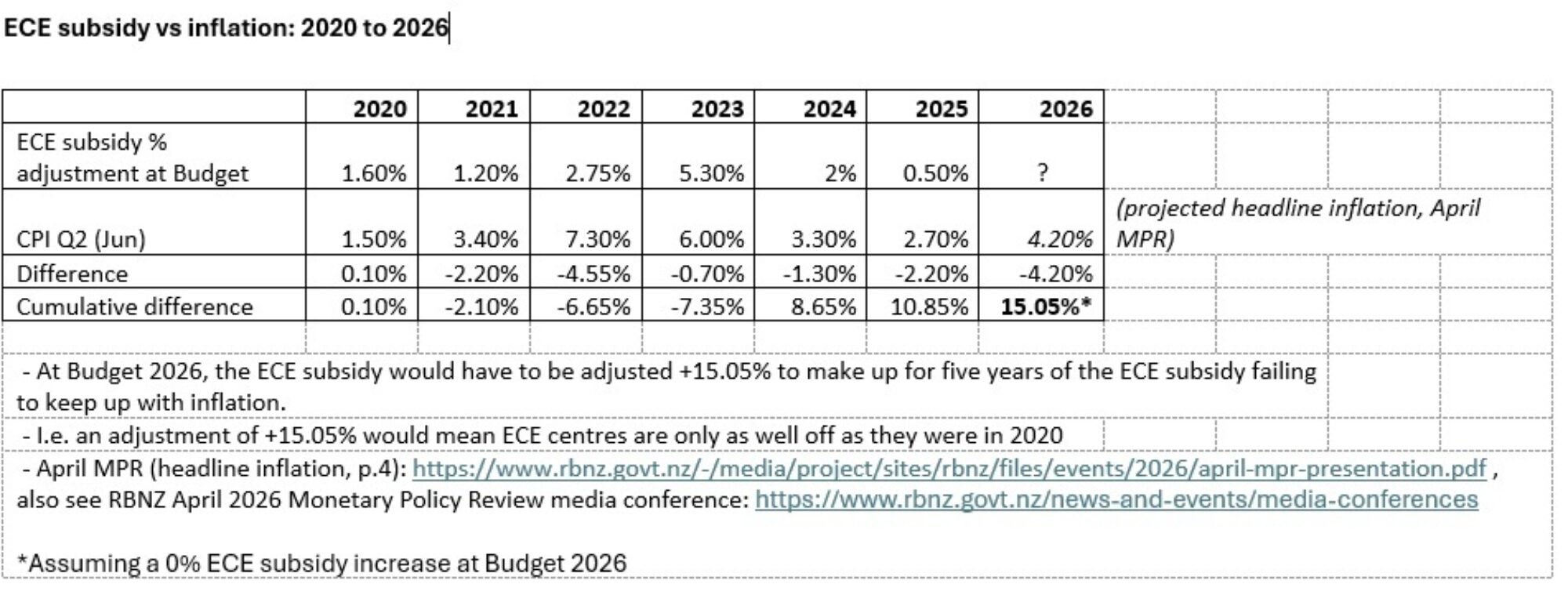
Government funding for early childhood education (ECE) has fallen behind inflation by up to 15% since 2020, forcing centres to raise fees and locking families out of affordable education and care.
New analysis by NZEI Te Riu Roa shows that a 15.05% ECE subsidy increase is needed in this year’s Budget to reverse six years of cumulative underinvestment.
“Year after year, the government’s adjustments have lagged far behind economic pressures, leaving ECE providers to absorb the gap between rising operational costs and stagnant funding,” NZEI Te Riu Roa Senior Strategic Researcher Dr Shannon Walsh said. “A 15.05% adjustment is the minimum required to return centres to the financial baseline they had in 2020.”
“Early childhood services are being squeezed, forcing them to drive up fees and making education and care increasingly unaffordable for families,” NZEI Te Riu Roa President Ripeka Lessels said. “Without a major adjustment in Budget 2026, more families will be priced out of the early education their children need.”
NZEI Te Riu Roa member leader Sally Griffin said this widening financial squeeze is creating a crisis for parents, who are already struggling with the cost of living without any meaningful relief from the National-led coalition government.
“Studies show that funding high-quality early childhood education is essential in creating a healthy, thriving society. With 90% of brain development occurring before the age of five, high-quality early childhood education is critical to positive lifelong outcomes. However, this consistent underfunding is compromising quality education during a critical period in a child’s development.”
Ms Griffin noted that the government’s Family Boost scheme has failed to provide relief. Instead, it has introduced administrative hurdles, forcing centres to redirect educational resources toward helping families complete quarterly paperwork.
Furthermore, Ms Griffin said the current funding structures are penalising centres that prioritise quality staff-to-child ratios, experienced qualified teachers, and low fees.
“The government must commit to adequate funding that supports kaiako and kaimahi delivering the best educational outcomes,” she said.
“The majority of ECE teachers and support staff have received low to no pay increases since the coalition government came into power in late 2023. Funding must prioritise wages to attract and retain the qualified educators necessary to maintain high quality and safe ratios.”
Teachers have also faced cuts to pay parity rates for new teachers, relief teachers, and those on fixed-term agreements under the current government.
“Ultimately, this government promised improvements to early childhood education, but so far the outcomes are bad for everyone – teachers, providers, and children,” Mrs Lessels said. “Learning support is in a dire state, making teaching conditions more challenging. Last year’s budget simply resulted in early intervention being cut from those in early childhood education.”
Mrs Lessels added that developments overseas highlight the risks of reducing quality in the sector.
“The recent New South Wales ECE inquiry report outlines the negative impacts on quality that result when regulations and funding are reduced. It clearly connects for-profit services with lower quality and higher risks to children,” Mrs Lessels said. “The government needs to heed these findings and address the funding shortfall before our ECE services face a similar crisis.”